When Your Heart Hasn’t Caught Up With What Your Mind Knows
There is a particular kind of tension that can happen in our faith when our minds arrive somewhere before our hearts do.
You may have studied something, prayed about it, talked it through with people you trust, and come to believe that something is true. You may even feel confident about what you think God is asking of you. Yet somewhere beneath all of that certainty, there is still a quiet hesitation.
Your heart has questions your mind hasn't answered.
I have experienced this in my own journey, and I have learned that it can be tempting to interpret that tension as a sign that something is wrong. We can assume that if we really trusted God, we wouldn't still be wrestling. If we really believed, we wouldn't need to keep asking. If we were walking in faith, surely we would feel completely at peace.
I don't think that's always how faith works.
Sometimes the mind understands before the heart feels safe enough to follow. Sometimes God allows us to spend a season seeking, questioning, studying, and wrestling because He is doing something deeper than simply giving us an answer.
He is teaching us to trust Him.
What Do You Do When You Have Questions About Your Faith?
For much of my life, I assumed that questions about faith were something I needed to resolve as quickly as possible.
There is a certain comfort in certainty. We like knowing where we stand, knowing what we believe, and knowing that we have a clear answer when someone asks us why.
But faith can become much more complicated when you begin asking questions that don't have easy answers.
Sometimes those questions come because you're genuinely curious. Sometimes they come because you've encountered something in Scripture that doesn't fit neatly into what you've always been taught. Sometimes they come because you're learning about another Christian tradition and realizing that the history of Christianity is much older and more complicated than the version you grew up hearing.
And sometimes the questions simply won't leave you alone.
I know what it feels like to reach that place.
When I began seriously examining the roots of Christianity and wrestling with questions surrounding the Catholic Church, I spent an enormous amount of time researching. I read arguments from Protestant and Catholic perspectives. I listened to debates. I studied history. I looked at Scripture. I tried to understand the early Church.
I wanted truth, not simply an answer that made me comfortable.
There were times when I felt like I had worked through something intellectually, only to realize that my heart was still sitting there asking, "But are you sure?"
That question can be uncomfortable.
It can also be an invitation.
God Is Not Afraid of Your Questions
One of the most comforting things I've learned through seasons of discernment is that God does not need me to pretend.
If I'm confused, He already knows.
If I'm afraid, He already knows.
If I'm wrestling with something that I don't understand, I don't have to clean that up before I bring it to Him.
Jesus Himself tells us to ask, seek, and knock.
"Ask and it will be given to you; seek and you will find; knock and the door will be opened to you."
Matthew 7:7
I love that these words leave room for movement.
Asking means I don't know.
Seeking means I haven't found the answer yet.
Knocking means I'm still waiting for the door to open.
Jesus doesn't tell us that we have to begin with perfect understanding. He invites us into the process of seeking Him.
That has changed the way I think about questions in my own faith.
Rather than seeing every question as evidence that my faith is weak, I can bring those questions directly to God and ask Him to lead me toward truth.
That requires humility because it means being willing to discover that something I believed before may need to change.
It also requires trust because sometimes the answer doesn't come immediately.
Sometimes Your Heart Needs More Than an Explanation
There came a point in my own discernment when I realized that I had done everything I knew how to do intellectually.
I had researched.
I had listened.
I had read.
I had asked questions.
I had tried to understand every side of the arguments.
And eventually, I found myself praying something much simpler:
"Lord, I give You my heart. Do with it whatever You please."
That prayer felt different.
For months, I had been asking God to help me understand. Now I was asking Him to have my heart, whether or not the answer was what I expected.
That distinction matters.
We can spend so much time asking God to give us the answer we want that we forget to surrender ourselves to the God who gives the answer.
There is a difference between saying, "God, show me that I'm right," and saying, "God, show me what is true, even if it changes me."
The second prayer requires surrender.
It also creates space for God to work in places that research alone can't reach.
Because sometimes the information is already there. What needs to change is our willingness to receive it.
Discernment Requires Both Courage and Surrender
I think one of the hardest parts of discernment is accepting that following God may cost us something.
We often talk about God's will as though obedience will always make our lives easier. Sometimes it does bring an incredible sense of peace. But obedience can also require us to leave behind things that once felt secure.
That was something I had to wrestle with during my own journey.
I knew that seriously questioning my Protestant background and moving toward Catholicism could change relationships, opportunities, and parts of my life that I had built over many years. I knew there could be misunderstanding. I knew people would have opinions. I knew some people would not understand why I was asking these questions in the first place.
And yet there was a deeper question underneath all of that:
What if following Jesus requires me to go somewhere unfamiliar?
I think we sometimes confuse comfort with confirmation.
Just because something is easier doesn't necessarily mean it is where God is leading us. And just because something is difficult doesn't automatically mean God is asking us to do it either.
That is why discernment requires prayer, Scripture, wisdom, patience, and a willingness to surrender our own expectations.
We have to become more concerned with knowing God than protecting our preferred outcome.
What Happens When the Heart Finally Catches Up?
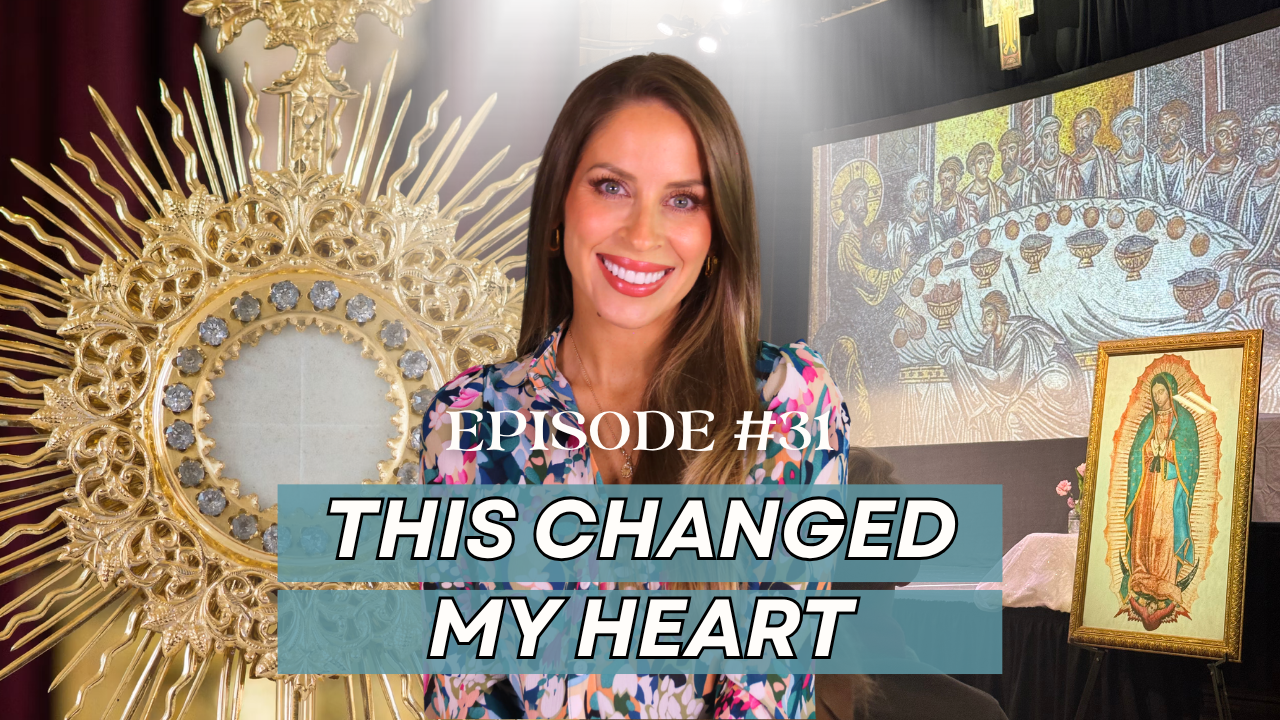
One of the most profound experiences of my journey happened during Eucharistic adoration at a Catholic conference.
I had already spent months wrestling intellectually with Catholic teaching about the Eucharist and Mary. I had studied the theology. I had considered the arguments. I understood much more than I had when I began.
But understanding something intellectually and experiencing a deep conviction in your heart can be two very different things.
During adoration, I found myself praying again.
I looked at the Eucharist and asked God to make His presence clear to me. I wanted to know whether what the Catholic Church teaches about the Eucharist was really true.
As I prayed, my attention was drawn toward an image of Our Lady of Guadalupe.
Mary had always been one of the most difficult parts of Catholicism for me to understand. Coming from a Protestant background, I had been taught to be very cautious about Marian devotion. I had heard the familiar concerns about Catholics giving Mary too much attention, and those concerns had shaped the way I approached her for years.
But in that moment, something shifted in how I saw her.
I found myself thinking about Mary through the eyes of her Son.
I thought about Jesus' words from the cross in John 19:26-27, when He tells John, "Behold, your mother."
For the first time, I experienced Mary less as a theological question I needed to solve and more as a mother whom Jesus Himself had entrusted to His followers.
I felt an overwhelming sense of peace.
I want to be careful about how I describe experiences like this because I know that private spiritual experiences are personal. They aren't something I can demand that another person accept simply because they happened to me.
But I can tell you what happened to my own heart.
It softened.
And then, as the Eucharistic procession continued, something happened that felt like God was answering a question I had been carrying for months. The worship team began singing a song I had heard many times before, including the words about incense rising day and night.
I had thought about those words months earlier at a completely different Christian event. I remembered singing about incense while realizing that the physical reality of incense wasn't actually part of the worship environment around me.
Now I was standing in a Catholic church surrounded by incense, watching the Eucharistic procession, hearing that same song.
For me, it felt like the pieces were suddenly connecting.
My heart finally caught up with what my mind had been wrestling with for so long.
Peace Doesn't Always Mean You Understand Everything
I've thought a lot about that experience since then.
One of the biggest things I've taken away from it is that peace isn't necessarily the same thing as having every question answered.
There will always be things about God that I don't understand.
There will always be theological questions that require more study.
There will always be mysteries that are bigger than my ability to comprehend them.
Christian faith doesn't require me to become someone who has an answer for everything.
It requires me to become someone who is willing to keep seeking Christ.
That distinction has brought me a lot of freedom.
I don't have to be afraid of questions.
I don't have to rush through uncertainty.
I don't have to pretend to have reached a place that I haven't reached yet.
I can simply keep bringing my questions to Jesus.
What If You're in That Place Right Now?
Maybe you're reading this because you're wrestling with something in your own faith.
Maybe you've encountered a teaching that you don't understand.
Maybe you're questioning something you've believed your entire life.
Maybe you're exploring Catholicism and aren't sure what to make of everything you're discovering.
Maybe you're experiencing doubts that you haven't told anyone about because you're afraid of what they'll think.
Or maybe your questions have nothing to do with theology at all.
Maybe you're asking God what to do with your family, your career, your relationships, your future, or a decision that feels much bigger than you.
Whatever it is, I want to encourage you not to be afraid of the process of seeking.
Bring God the real question.
Bring Him the fear underneath it.
Bring Him the parts of your heart that are still hesitant.
And then give Him permission to lead you somewhere you didn't expect to go.
You can pray something as simple as:
"Jesus, I want to know You. I want to know what is true. I am willing to follow You wherever You lead me. Please give me the grace to recognize Your voice and the courage to follow it."
Then keep seeking.
Read Scripture.
Pray.
Learn from Christians who have faithfully walked before you.
Ask thoughtful questions.
Listen to people who disagree with you instead of only listening to people who confirm what you already believe.
And give your heart time.
Faith Is a Journey of Becoming
I've come to believe that faith is much more beautiful when we stop expecting ourselves to arrive all at once.
God is patient.
He can work through our intellect, our emotions, our questions, our experiences, our relationships, and even the things we thought we understood already.
Sometimes He answers with a Scripture passage.
Sometimes through a conversation.
Sometimes through months of study.
Sometimes through an unexpected moment of peace.
And sometimes the answer comes so quietly that we only recognize it later.
Our responsibility is to remain open.
I don't know exactly where you are in your own journey right now. Maybe you have complete confidence in what you believe. Maybe you're questioning everything. Maybe you're somewhere in between.
Wherever you are, I hope you remember that you don't have to be afraid to seek.
Jesus doesn't ask us to stop asking.
He asks us to come closer.
So if your mind has arrived somewhere and your heart is still trying to catch up, give yourself permission to stay with Jesus in that space.
Keep asking.
Keep seeking.
Keep knocking.
And most importantly, keep giving Him your heart.
Because sometimes the answer we're looking for isn't simply a piece of information.
Sometimes what we're really asking for is to know Him more deeply.
And He is faithful to meet us there.




FOLLOW ME ON INSTAGRAM