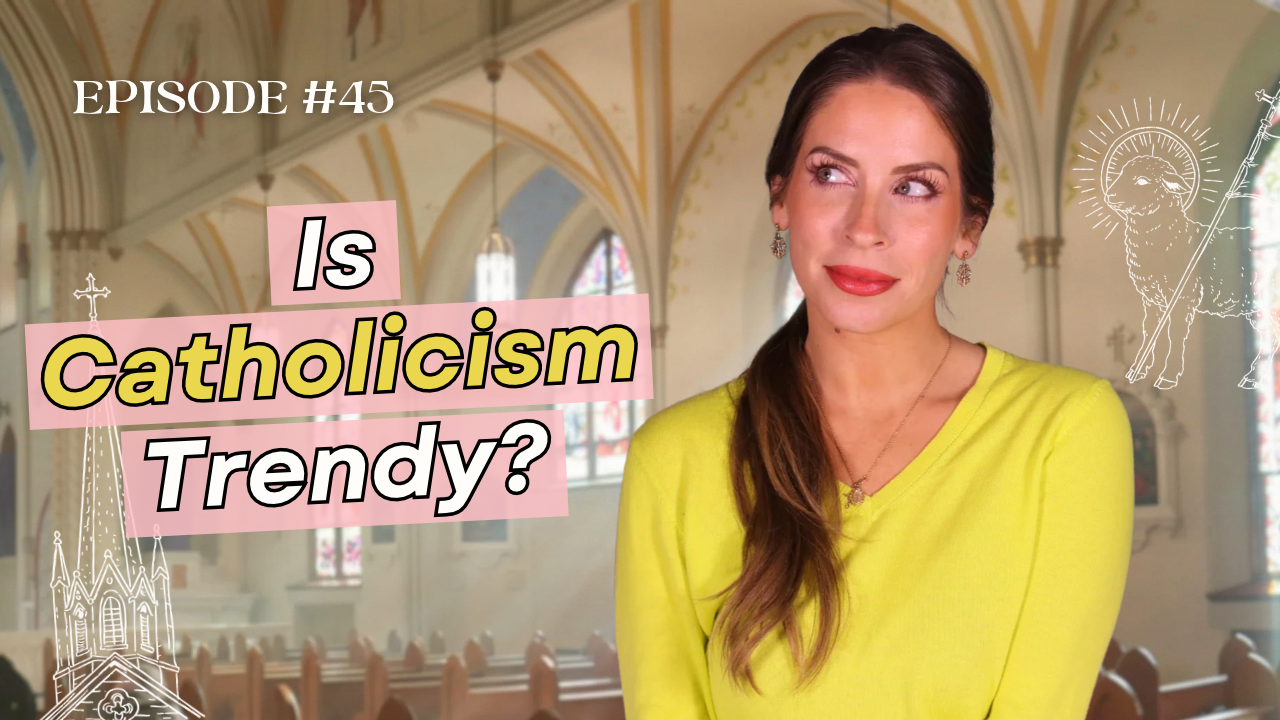
Have you noticed how much more people seem to be talking about Catholicism lately?
Maybe you've seen conversations about the early Church on social media, heard about someone leaving their evangelical church, or noticed a growing interest in ancient Christian traditions. For some, it might seem like Catholicism is suddenly becoming popular, especially among younger Christians.
But I think there's a much deeper conversation happening here, and it's one that has become incredibly personal to me.
As someone who grew up in evangelical Christianity, I never imagined I'd find myself questioning so many of the things I had always believed about the Catholic Church. I was grateful for my upbringing, and I still am. There was so much beauty in the Christian communities that helped shape my faith.
But as I began studying Church history for myself, I started realizing just how much of Christianity's history I had never really explored.
And the more I learned, the more questions I had.
Why Church History Matters More Than We Realize
One of the things that initially surprised me about studying the early Church was realizing how little I knew about the Christians who came before us.
We read Scripture, attend church, and learn from pastors and teachers, but how often do we stop to consider how the earliest Christians understood the very same passages we're reading today?
For me, that question became increasingly important.
I wanted to know what Christians believed in the first few centuries after Jesus' resurrection. How did they worship? How did they understand the Eucharist? What did they believe about the authority of the Church, and how did they interpret Scripture?
These questions eventually led me to the writings of the early Church Fathers, and I began discovering teachings and practices that were unfamiliar to me despite having spent my entire life in Christian communities.
It was humbling to realize that I had spent so much time learning about Christianity without fully understanding its history.
If we genuinely want to understand our faith, I believe we should be willing to learn from the Christians who lived much closer to the time of the apostles.
That doesn't mean we stop reading Scripture for ourselves. It means we approach Scripture with the humility to recognize that Christians have been studying, teaching, and preserving these writings for nearly two thousand years.
And perhaps there's something we can learn from them.
The Questions That Come With Seeking Truth
I think one of the most uncomfortable parts of growing in our faith is realizing that we might have misunderstood something.
Most of us don't intentionally hold beliefs that we think are false. We trust the people who teach us, especially when those people have played an important role in our spiritual lives.
But sometimes, we inherit assumptions without ever taking the time to investigate them.
That was certainly true for me when it came to Catholicism.
Because of my background in journalism, I was taught the importance of looking at different perspectives before drawing conclusions. Yet when I started applying that same principle to my understanding of the Catholic Church, I realized that many of my assumptions had come from people outside the Church rather than from what Catholics actually taught.
I began asking myself why I had never gone directly to the source.
And that led to a much bigger question: Was I willing to follow the evidence, even if it challenged what I had always believed?
John 8:32 says, "Then you will know the truth, and the truth will set you free."
I've thought about that verse quite a bit throughout this journey because seeking truth requires humility. Sometimes it means acknowledging that we have more to learn, even about subjects we thought we understood.
And while that can be uncomfortable, I think it's an important part of spiritual growth.
Why Ancient Christianity Is Drawing People In
As I've continued learning about the early Church, I've noticed that I'm far from the only person asking these questions.
More Christians are becoming interested in apostolic Christianity, particularly the historical continuity, traditions, and sacramental life of the Catholic Church.
And I can understand why.
For those of us who grew up in Protestant or evangelical environments, there can be significant differences in how various denominations interpret Scripture and approach Christian doctrine.
Questions surrounding baptism, communion, Church authority, and other important teachings can receive very different answers depending on which Christian community you ask.
Eventually, that can lead someone to wonder how the earliest Christians understood these things.
It's a question that deserves thoughtful consideration.
For me, studying the Catholic Church's understanding of apostolic succession and the Eucharist opened up an entirely new perspective on Christian history. I began to understand why the preservation of teaching and tradition matters so deeply within Catholicism.
And the more I studied, the more I found myself drawn toward that historical continuity.
I also began to appreciate the reverence and structure of Catholic worship in a way I hadn't before. There's something deeply meaningful about participating in practices that connect Christians across generations.
During a recent pilgrimage to Baltimore and Washington, D.C., I had the opportunity to visit beautiful cathedrals, monasteries, and shrines alongside other people who were exploring many of these same questions.
After spending so much time reading about the history of Christianity, there was something incredibly special about experiencing those places in person.
It reminded me that the Christian faith has a history much bigger than my own experiences, and I felt grateful to be learning more about it.
Learning to Approach Our Faith With Humility
One of the biggest lessons I've taken away from this journey is how important humility is when we're studying our faith.
Proverbs 3:5 reminds us to trust in the Lord with all our hearts and lean not on our own understanding.
I think that's especially meaningful when we're navigating questions about theology, tradition, and the Church.
It's easy to assume that the way we've always understood something must be the correct interpretation. After all, our beliefs are often connected to the people and communities we love, which can make questioning them feel deeply personal.
But I don't think we should be afraid of learning more.
I've had to become comfortable admitting that there are things I didn't know, teachings I misunderstood, and questions I had never thought to ask.
And while I know that conversations about Catholicism and Protestantism can sometimes become heated, I really hope we can approach them with more patience and a genuine desire to understand one another.
We can be grateful for the ways God has worked in our lives while continuing to examine what we believe and why we believe it.
For me, that process has led to a deeper appreciation for the Catholic faith and the history of Christianity.
Is Catholicism Really Becoming Trendy?
So, is Catholicism becoming trendy?
I can understand why someone might ask that question. We have access to more conversations about theology and Church history than ever before, and social media has made it much easier to discover perspectives we might never have encountered otherwise.
But I think it's worth considering what happens after someone becomes curious.
For many people, that initial curiosity leads to reading books, studying Scripture, exploring the writings of the early Church Fathers, and having conversations with people who understand Catholic teaching.
Sometimes it even leads to visiting a Catholic Mass for the first time.
Those are meaningful steps, and they often involve a great deal of personal reflection.
I know from my own experience that seriously reconsidering long-held beliefs can be emotional and sometimes lonely. It can affect relationships and challenge the way you've understood your faith for years.
That's why I think we should be careful about dismissing someone's spiritual journey as simply following a trend.
For many of us, this search has required more study and prayer than we ever anticipated.
And wherever you find yourself in that conversation, I hope you'll be willing to approach it with curiosity and humility.
There's so much to learn about the history of Christianity, and I think we're incredibly fortunate to live in a time when so many of those resources are readily available.
If you've been wondering why more Christians are exploring Catholicism, I recently shared a deeper conversation about this on the Lighten Up Podcast. I talk about my own experience, what I've been learning about the early Church, and some of the reasons others are feeling drawn toward apostolic Christianity.
Continue the Conversation on Lighten Up
Whether you're exploring these questions yourself or simply trying to understand someone else's journey, I hope this encourages you to keep learning and asking thoughtful questions.
There's always more to discover, and I'm grateful for the opportunity to continue growing in my understanding of the Christian faith.



FOLLOW ME ON INSTAGRAM