Are Catholic Icons Idolatry? Understanding Icons, Saints, and Sacred Images
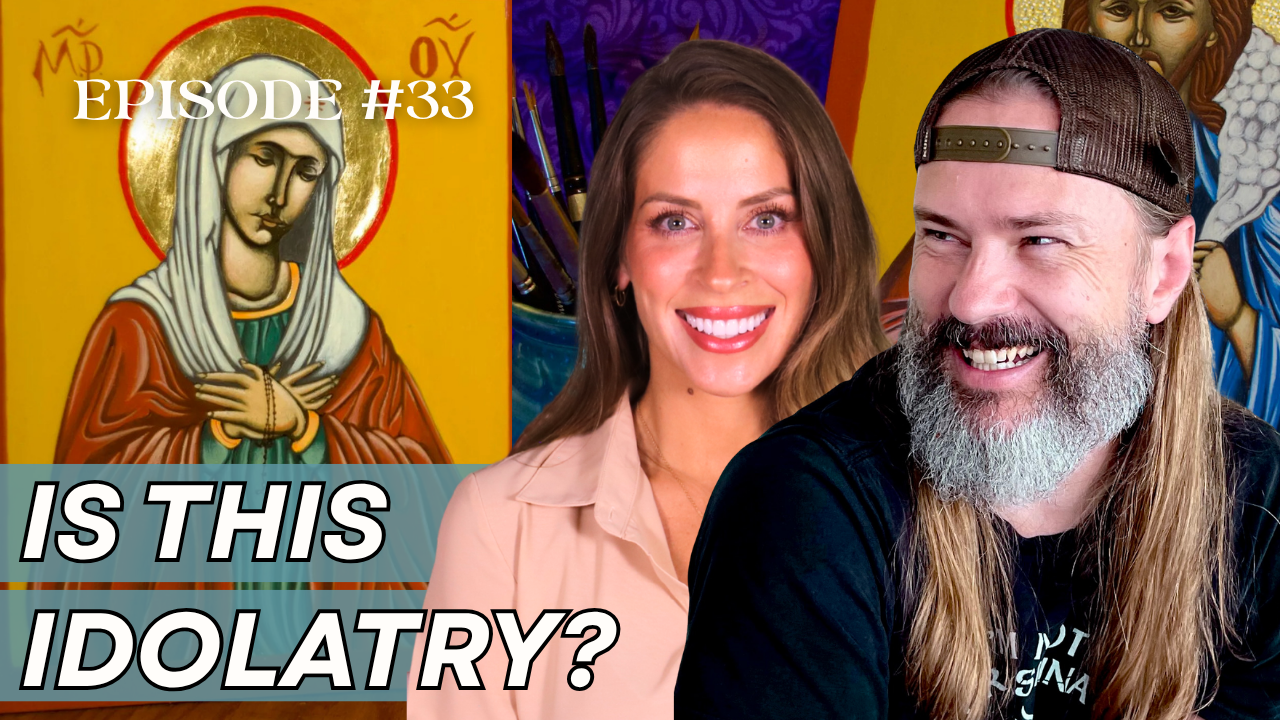
Are Catholic Icons Idolatry? What Catholics Actually Believe About Sacred Images
There are certain questions about Catholicism that seem to come up over and over again, especially for those of us who grew up Protestant.
Why do Catholics have statues?
Why do they pray to saints?
Why do they kiss icons?
And perhaps the biggest question underneath all of those: Isn't that idolatry?
I understand why these questions come up because I grew up with many of the same assumptions. When you have spent your entire life hearing that Catholic statues and icons are examples of "graven images," it can be difficult to look at those practices through a different lens. Even when you begin exploring Catholicism, there can be a lot to unpack because the vocabulary, traditions, and ways of expressing faith can feel unfamiliar.
But the more I have learned about the Catholic faith and the history of Christianity, the more I have realized that some of these questions require us to slow down and ask what the Church actually means by these things.
That is especially true when it comes to icons.
What Is an Icon?
The word icon comes from the Greek word eikōn, which means "image."
In the Catholic and Eastern Christian traditions, an icon is much more than simply a religious painting. It is a sacred image that represents Christ, the Blessed Virgin Mary, a saint, an angel, or a particular event in salvation history.
The purpose of an icon is to point beyond itself.
An icon of Christ is not meant to become Christ. An icon of Mary is not Mary herself. An icon of a saint does not contain the saint or possess some supernatural power of its own. Instead, the image directs our attention toward the person it represents and, ultimately, toward God.
This is one reason I love the way the iconographer Garrett Heinz described icons in a conversation I had with him. He explained them as a kind of "window" into heaven. The image gives us something visible that helps direct our attention toward an invisible reality.
That idea has really stayed with me.
Our faith is filled with invisible realities that we cannot physically see. We cannot see heaven with our earthly eyes. We cannot see the communion of saints surrounding us. We cannot see the angels worshiping before God.
Yet Christianity has always been deeply incarnational.
God Himself became visible.
Jesus Christ took on flesh. He entered human history. He had a human face that people could see, hands that people could touch, and a body that could be crucified.
So the question of whether Christians can use physical images to direct their hearts toward God is actually much deeper than simply asking whether a painting or statue exists.
The more important question is what that image is doing.
What Is the Difference Between an Icon and an Idol?
This distinction helped me understand the issue so much more clearly.
An idol is something that is treated as a god. It is given the worship that belongs to God, or it becomes an object through which someone believes they can manipulate or access supernatural power.
An icon is completely different.
An icon does not claim to be God. It does not contain God. It does not become the person it represents.
Instead, it directs us toward God.
That distinction matters because Scripture itself shows us that God did not forbid every kind of sacred image.
If the commandment against graven images meant that absolutely no religious image could ever be made, there would be a serious problem with several things God Himself commanded in the Old Testament.
For example, in Exodus 25, God instructed Moses to have two cherubim made for the Ark of the Covenant. These were physical representations of heavenly beings.
In Numbers 21, God commanded Moses to make a bronze serpent, which the Israelites were instructed to look upon for healing.
The Temple built by Solomon was also filled with sacred imagery, including cherubim, palm trees, and flowers.
The problem, then, was not the existence of images.
The problem was idolatry.
An image becomes an idol when we give it something that belongs to God alone.
That distinction is important because we already understand this concept in other parts of our lives.
If I have a photograph of someone I love, I do not believe that the person is literally contained inside the photograph. I may look at that photograph and feel love, gratitude, or even grief because the image reminds me of someone who is real.
The photograph points me toward the person.
In a similar way, a sacred image can direct our attention toward Christ, His mother, or one of the saints.
The image is not the destination.
It is a reminder of the destination.
Why Do Catholics Have Statues and Images?
I think this is where the conversation becomes especially practical.
We are visual people.
We fill our homes with photographs of the people we love. Children put posters of athletes and musicians on their walls. We keep wedding photos, family portraits, paintings, artwork, and meaningful objects around us because physical reminders matter to us.
Why?
Because we forget.
We can know something intellectually and still need reminders of it throughout the day.
Our Catholic faith is no different.
A crucifix reminds me of Christ's sacrifice when I walk past it.
An image of Mary can remind me of the woman who gave her complete "yes" to God.
An image of a saint can remind me that holiness is possible and that ordinary human beings really can give their entire lives to Christ.
The point is not to stop at the image.
The point is to let the image turn our hearts toward the reality it represents.
This is why the saints can be such a beautiful part of the Christian life. Their lives give us concrete examples of what it looks like to follow Jesus.
When I look at the life of a saint, I can ask myself, What would it look like for me to love Christ like that?
That is a very different question from, How can this image do something for me?
One directs my heart outward toward God.
The other turns my attention inward toward myself.
Why Do Catholics Pray to Saints?
This is another place where the language can create confusion.
When Catholics say that they "pray to" a saint, they are not worshiping that saint or treating the saint as God.
The word pray historically has a broader meaning than we sometimes use in everyday Christian conversation. To pray can mean to ask or make a request.
If I ask a friend, "Will you pray for me?" I am asking that person to bring my needs before God.
Catholics believe that the saints in heaven are alive in Christ and can intercede for us. So asking Saint Patrick or Saint Thérèse to pray for us is ultimately asking a member of the family of God to join us in bringing our prayers before Him.
That is very different from worship.
Jesus Christ remains the one mediator between God and humanity, and everything the saints do points us back toward Him.
I actually find this understanding of the saints incredibly beautiful because it reminds me that Christianity is not something I am meant to live alone.
Hebrews describes the saints who have gone before us as a "great cloud of witnesses."
That is such a powerful image.
The Christian life is a race, and we have people who have already run it faithfully before us.
Their lives encourage us.
Their prayers support us.
Their example challenges us.
And their presence reminds us that the goal is worth pursuing.
Why Do Catholics Kiss Icons?
This can be one of the hardest practices for someone unfamiliar with Catholic or Eastern Christian traditions to understand.
Why would someone kiss a statue or an icon?
Again, the distinction comes down to what the action means.
When someone kisses an icon of Christ, they are not believing that paint and wood have somehow become God. The physical action expresses love and reverence toward the person represented.
We already do similar things in ordinary life.
We might kiss a photograph of a loved one. We might hold a wedding ring and feel deeply connected to the person we married. We might carefully preserve a handwritten letter because of who wrote it.
The physical object matters because of the person it represents.
There is also an important distinction within Catholic worship between the worship owed to God and the honor given to His saints.
The adoration that belongs to God alone is not the same thing as the veneration given to Mary and the saints. Catholics do not believe that Mary is God, nor do they believe that the saints are gods.
There is a hierarchy of honor because there is a difference between God and His creatures.
And that difference matters.
A Catholic can love Mary deeply without confusing Mary with Jesus.
In fact, the whole purpose of Mary's life is to point us toward her Son.
Sacred Images Have Been Part of Christianity From the Beginning
One of the assumptions I had to reconsider as I learned more about Catholicism was the idea that many of these traditions were medieval inventions.
That idea is easy to encounter, particularly when people suggest that Catholic practices developed centuries after Jesus and became mixed with paganism.
But Christianity has a much older relationship with sacred imagery.
Christian art appears very early in Christian history. Ancient Christian communities used images to represent Christ, biblical scenes, and figures associated with the faith.
There were also significant theological debates within the early Church about the proper use of images, most notably during the period of Byzantine iconoclasm. Christians seriously wrestled with the question of whether sacred images were appropriate and how they should be honored.
Eventually, the Church affirmed the use of sacred images while maintaining the crucial distinction between honoring an image and worshiping the thing represented.
That history matters because it reminds us that Catholic iconography did not suddenly appear during the Middle Ages as some random addition to Christianity.
The Christian tradition has a long history of using physical things to point toward spiritual realities.
And that makes sense when you remember the heart of Christianity itself: the Word became flesh.
God chose to enter the physical world.
He chose to be seen.
He chose to be touched.
He chose to communicate His love through things we could experience with our physical senses.
Christianity has never been a faith that teaches us to despise the physical world. Instead, creation can point us toward its Creator.
What We Look At Shapes Us
This might actually be the part of this entire conversation that has challenged me the most.
What we look at matters.
Our attention is constantly being directed somewhere.
Every day, we fill our minds with images, stories, people, advertisements, social media, entertainment, and news. We surround ourselves with reminders of what the world tells us is valuable.
So what happens when we intentionally put reminders of Christ in front of ourselves?
What happens when our homes contain visible reminders of the people who lived radically for Him?
What happens when we look at a crucifix and remember that Jesus loved us enough to suffer for us?
What happens when we see an image of a saint and remember that holiness is actually possible?
I think this is part of what Scripture means when it tells us to keep our eyes fixed on Jesus.
Hebrews 12:1–2 tells us that we are surrounded by a great cloud of witnesses and calls us to run our race with endurance, "looking to Jesus, the founder and perfecter of our faith."
Our eyes need somewhere to go.
Our hearts need something to remember.
And our lives need examples of what faithful discipleship can actually look like.
The saints can help with that.
Sacred images can help with that.
A crucifix can help with that.
None of these things replace Jesus.
They help us remember to look toward Him.
Let Your Surroundings Point You Toward Heaven
I think we should be intentional about the things we place in front of ourselves.
That does not mean every inch of our homes needs to become a chapel. It does not mean we need to immediately understand every Catholic tradition or practice. It simply means we can begin asking ourselves a very simple question:
What is directing my attention?
Because we are all being formed by something.
The question is whether we are being formed intentionally.
Maybe that means keeping a crucifix somewhere you will see it throughout the day. Maybe it means learning about a saint whose life inspires you. Maybe it means spending time in front of an icon during prayer and allowing yourself to become quiet enough to remember the person represented there.
Whatever it looks like, the goal is the same: to lift our eyes beyond ourselves.
The saints are not competing with Jesus.
Mary is not competing with Jesus.
An icon is not competing with Jesus.
When these things are rightly understood, they all point us back to Him.
And perhaps that is what I find most beautiful about sacred art.
A good icon does not ask me to stay there.
It invites me to look through it.
To remember heaven.
To remember the saints who have gone before me.
To remember the sacrifice of Christ.
And then, with my eyes fixed on Jesus, to get back up and keep running the race.




FOLLOW ME ON INSTAGRAM