What Did the Protestant Reformers Really Believe? What Luther & Calvin Taught
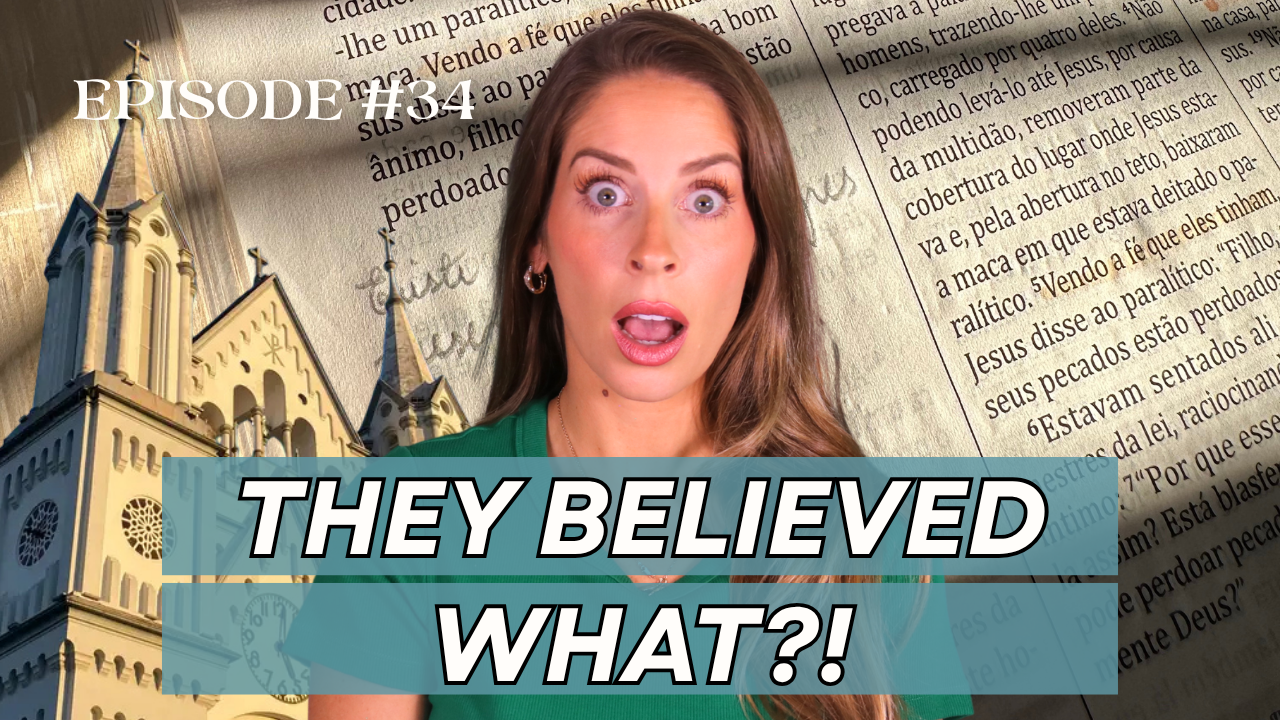
There is a particular kind of humility that comes with realizing you might have been wrong about something you were completely sure you understood.
I know that feeling because I’ve experienced it throughout my own faith journey. For years, I assumed I understood what Christians believed about certain doctrines because I had been taught those things from a young age. I knew what my church believed. I knew what my community believed. I knew the version of Christianity that had been handed down to me.
What I didn’t realize was how much I had never stopped to ask where those beliefs came from.
When I began looking more seriously at Christian history, the early Church, and the writings of the Christians who lived closest to the apostles, I found myself asking questions I had never thought to ask before. I also discovered that some of the Protestant Reformers held beliefs that would probably surprise many modern evangelicals.
Martin Luther and John Calvin, for example, did not simply believe everything that many modern Protestants associate with Protestant Christianity. On several important doctrines, their views were much closer to the beliefs of the early Church than I expected.
That realization led me to a much bigger question: If I want to know what Christianity actually teaches, how much should I care about what Christians believed before my own time?
For me, the answer has become clear. I care a lot.
Why Christian History Matters
When we read the Bible today, it can be tempting to assume that our interpretation is simply what the Bible has always meant. We open the text, read it through the lens of our own culture and experience, and naturally assume that Christians throughout history have understood it the same way.
But Christianity didn't begin with us.
There were Christians reading these same Scriptures long before our modern denominations existed. There were Christians worshiping, baptizing, celebrating the Eucharist, praying, teaching, and wrestling with difficult theological questions centuries before the Reformation.
That doesn't mean every early Christian got everything right. Christians have always been capable of making mistakes. But it does mean their beliefs and practices are worth taking seriously, especially when we are trying to understand how the earliest generations of Christians understood the teachings they had received.
This became especially interesting to me when I started studying the Protestant Reformation.
We often talk about the Reformers as though they all shared the same beliefs and completely rejected everything associated with the Catholic Church. But history is much more complicated than that.
Some of the Reformers rejected certain teachings and practices of the medieval Catholic Church while continuing to affirm doctrines that many modern Protestants have since rejected.
That raises an important question: What did the Reformers themselves actually believe?
Martin Luther and John Calvin on Infant Baptism
One of the biggest surprises for me was discovering that both Martin Luther and John Calvin defended infant baptism.
Today, many Christians assume that believer's baptism, in which someone makes a conscious profession of faith before being baptized, is the obvious biblical position. I grew up thinking of infant baptism as something distinctly Catholic.
But that wasn't Martin Luther's position.
Luther believed that infants could receive faith and that Scripture did not establish an age requirement for baptism. He defended the practice of baptizing infants and viewed baptism as much more than a symbolic ceremony.
John Calvin also defended infant baptism. He connected baptism to the covenant and saw a parallel between Christian baptism and circumcision under the Old Covenant. In his understanding, children of Christian families were included within God's covenant community.
This is important because it shows us that the question of infant baptism did not simply divide “Catholics” from “Protestants.”
There were significant disagreements among the Reformers themselves about baptism, including whether baptism was primarily a sign or whether something more substantial was taking place through the sacrament.
As I began learning about these disagreements, I realized that some of the beliefs I had assumed were obvious Protestant positions actually developed more fully after the first generation of Reformers.
That made me want to go further back.
What did Christians believe before the Reformation?
Was Baptism More Than a Symbol?
This question is bigger than whether a baby should be baptized.
It gets to the heart of what baptism actually does.
Some Christians today understand baptism primarily as an outward expression of an inward decision. Others understand it as a sacrament through which God actually gives grace.
When I started reading the early Christian writings and looking at the way Scripture talks about baptism, I found myself having to reconsider how easily I had reduced baptism to a symbol.
Throughout the New Testament, baptism is spoken about in remarkably significant terms. We see baptism connected with repentance, forgiveness, new life, union with Christ, and entrance into the Christian community.
Whatever conclusion someone ultimately reaches about baptism, I think we should be willing to take those passages seriously and ask why Christians in the earliest centuries understood baptism the way they did.
That is one of the reasons Christian history has become so fascinating to me. It gives us another perspective when we encounter questions that our own Christian culture may have already answered for us.
What Did Martin Luther Believe About the Eucharist?
The Eucharist was another discovery that genuinely surprised me.
Martin Luther did not believe that Communion was merely a symbol.
He strongly affirmed the real presence of Christ in the Eucharist. When Jesus said, “This is my body,” Luther believed those words needed to be taken seriously.
This is especially interesting because many modern evangelical churches understand Communion primarily as a memorial or symbolic act. That perspective became particularly associated with other figures of the Reformation, including Ulrich Zwingli, who disagreed with Luther on the nature of Christ's presence in the Eucharist.
So again, the history is more complicated than the categories we sometimes use today.
The early Christians were remarkably serious about the Eucharist, too. When you read the writings of the early Church Fathers, you encounter Christians speaking about the Eucharist in a way that goes far beyond the idea of simply remembering something Jesus did in the past.
That forced me to take another look at passages of Scripture I thought I already understood, especially Jesus' teaching in John 6.
If Christians who lived much closer to the apostles consistently understood these passages in a particular way, shouldn't that at least make us pause and investigate?
For me, the answer was yes.
I don't want to reject something simply because it sounds unfamiliar to me. If something is true, I want the truth, even when it stretches my understanding.
What Did the Reformers Believe About Mary?
Mary was probably the most difficult area for me personally.
Growing up in an evangelical environment, Mary wasn't someone we talked about very much. There was often a concern that giving Mary too much attention could somehow take attention away from Jesus.
But when I started reading the early Christian writings and the writings of the Reformers themselves, I discovered something I hadn't expected.
Martin Luther spoke about Mary with profound reverence.
He affirmed her perpetual virginity and referred to her as the Theotokos, meaning “Mother of God.” John Calvin also accepted the title Mother of God, which had been affirmed by the Council of Ephesus in the fifth century.
Luther also expressed a belief in Mary's preservation from original sin, which is another belief many modern Protestants would probably associate exclusively with Catholic theology.
That doesn't mean Luther agreed with every later Catholic teaching about Mary. He didn't. But it does challenge the idea that devotion to Mary or reverence for Mary was something invented much later by the Catholic Church.
The early Christians took Mary's role in salvation history seriously because Scripture itself gives her a remarkable place in the story of Christ.
Mary was the woman chosen to bear the Son of God.
She was present at the beginning of Jesus' earthly life and remained present at crucial moments throughout His ministry and Passion. She was there at the foot of the cross, and she appears with the apostles after the Resurrection.
Whatever conclusions we reach about Marian theology, it seems difficult to read Scripture honestly and conclude that Mary is unimportant.
The question is not whether Mary replaces Jesus. She doesn't.
The question is whether we are willing to understand Mary's role the way the earliest Christians understood it.
Why Would the Reformers Agree With the Early Church?
This was one of the questions that kept coming back to me.
If the Protestant Reformation was a rejection of Catholic teaching, why did some of the Reformers continue to hold beliefs that modern Protestants often reject?
The answer is partly that the Reformation was not a single movement in which everyone believed exactly the same thing.
The Reformers disagreed with one another on significant doctrines. Luther, Calvin, Zwingli, and the Anabaptists did not all have identical understandings of baptism, Communion, the Church, or other theological questions.
And those disagreements didn't suddenly disappear when the Reformation ended.
Over the centuries, Christianity continued to develop into an enormous number of different denominations and traditions, each with its own understanding of Scripture and doctrine.
That should make us humble.
I don't think it means we should simply accept everything that came before us without question. Christians are called to test what they believe against truth.
But I do think it should make us pause before assuming that our particular interpretation is obviously the one Christians have always held.
There is something incredibly humbling about realizing that Christians were wrestling with these questions long before we were.
What If We Don't Know As Much As We Think We Do?
This may actually be the most important lesson I've taken away from studying Christian history.
I don't want to be afraid of discovering that I was wrong.
I want to be more afraid of being unwilling to find out.
There is a difference.
If my goal is simply to defend what I already believe, then every new piece of information becomes a threat. I'll naturally look for reasons to dismiss anything that challenges me.
But if my goal is to know the truth, then new information becomes an invitation to investigate.
That requires humility.
It means I can say, “I don't know.”
It means I can admit that I was taught something incorrectly.
It means I can read someone from a completely different Christian tradition and genuinely try to understand what they believe before deciding whether I agree.
Most importantly, it means I can bring those questions to God.
Jesus told us to seek, and I don't think that was an accidental command.
“Ask, and it will be given to you; seek, and you will find; knock, and it will be opened to you.” — Matthew 7:7
Seeking requires movement. You have to be willing to open the door, ask the question, read the book, study the history, and sometimes admit that the answer is different from what you expected.
That can be uncomfortable, but it can also be incredibly beautiful.
The more I have learned about Christianity's history, the more I have realized that there is so much I still don't know. And instead of making me want to stop asking questions, that realization has made me want to keep going.
There is something beautiful about discovering that our faith has a history that stretches back thousands of years.
We aren't the first Christians to wrestle with difficult questions. We aren't the first people to open Scripture and wonder what a particular passage means. We aren't even the first generation to disagree about theology.
We have an entire history of Christians who came before us.
We should be humble enough to listen.
Seek the Truth, Even When It Challenges You
I don't think God is threatened by our questions.
If something is true, it can withstand examination.
That doesn't mean every question will have an immediate answer, and it doesn't mean every historical Christian got everything right. It simply means that we don't need to be afraid of seeking.
If you've always believed something about baptism, ask where that belief came from.
If you've always understood Communion as purely symbolic, take another look at what Scripture and the early Christians said about the Eucharist.
If you've never really thought about Mary's place in Christian history, study what the earliest Christians and even some of the Reformers believed about her.
You may discover that you were right all along.
You may discover that you weren't.
Either way, you have gained something valuable: you have pursued the truth instead of simply protecting what was familiar.
That is what I want for my own faith.
I don't want to settle for the version of Christianity that is most comfortable to me. I want to know Jesus more deeply. I want to understand Scripture faithfully. I want to learn from the Christians who came before me, especially those who were closest to the apostles.
And I want to keep seeking.
Because if Jesus really is who He says He is, then there is nothing to fear from following the truth wherever it leads.



FOLLOW ME ON INSTAGRAM